


Go to Homepage
Your temporary email is ready immediately
When you visit our homepage, you'll see:
- Your temporary email address already generated
- An empty inbox ready to receive emails
- Copy button next to your email address
- Refresh button to check for new emails
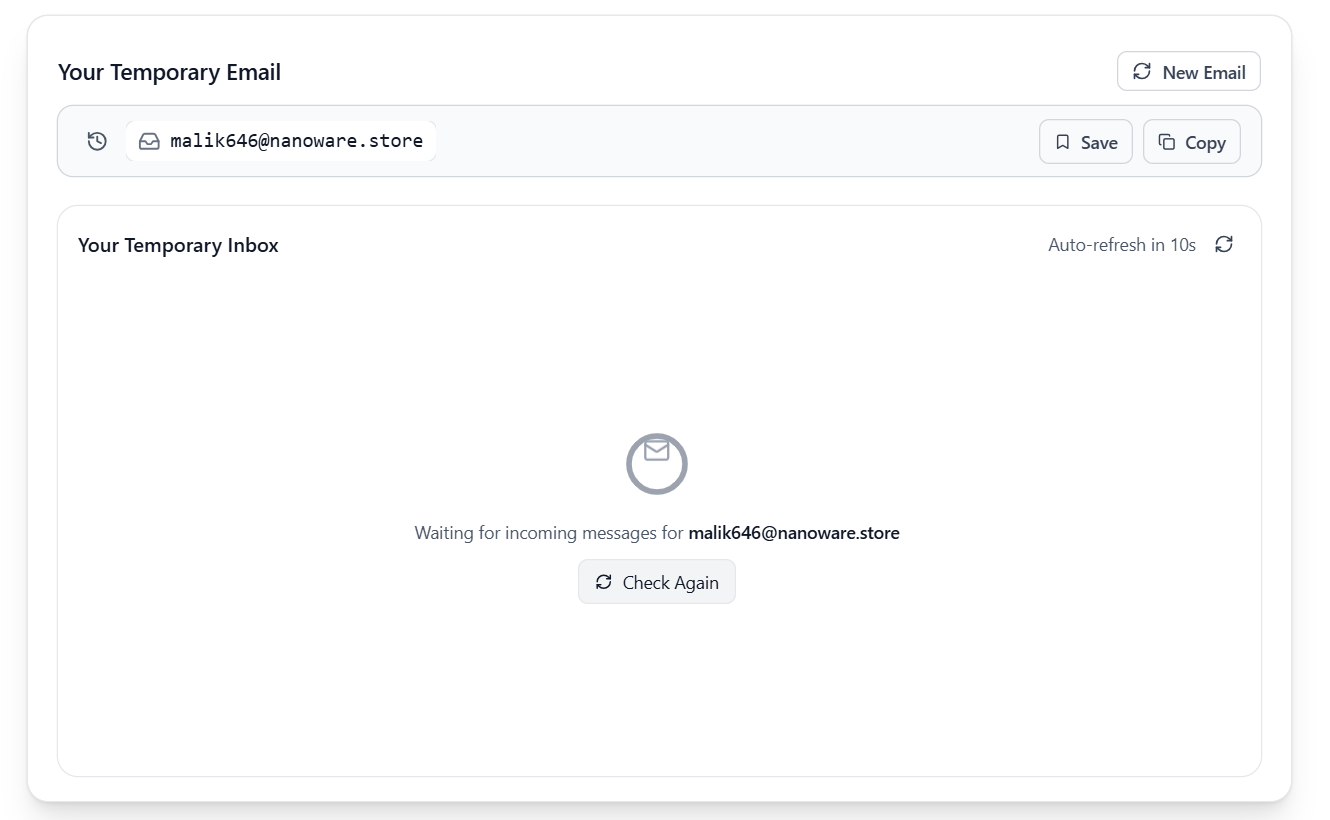
The homepage shows your temporary email address and empty inbox.
Copy Email Address
Use your temporary email for sign-ups
Click the copy button next to your email address. The email is now copied to your clipboard.
Use this temporary email address when signing up for websites, services, or newsletters.

Click the copy button to copy your temporary email address.
Receive Emails
Emails appear in your temporary inbox
Keep the TempMail tab open. Emails sent to your temporary address will appear here.
The inbox shows:
- Sender email address
- Email subject
- Time received
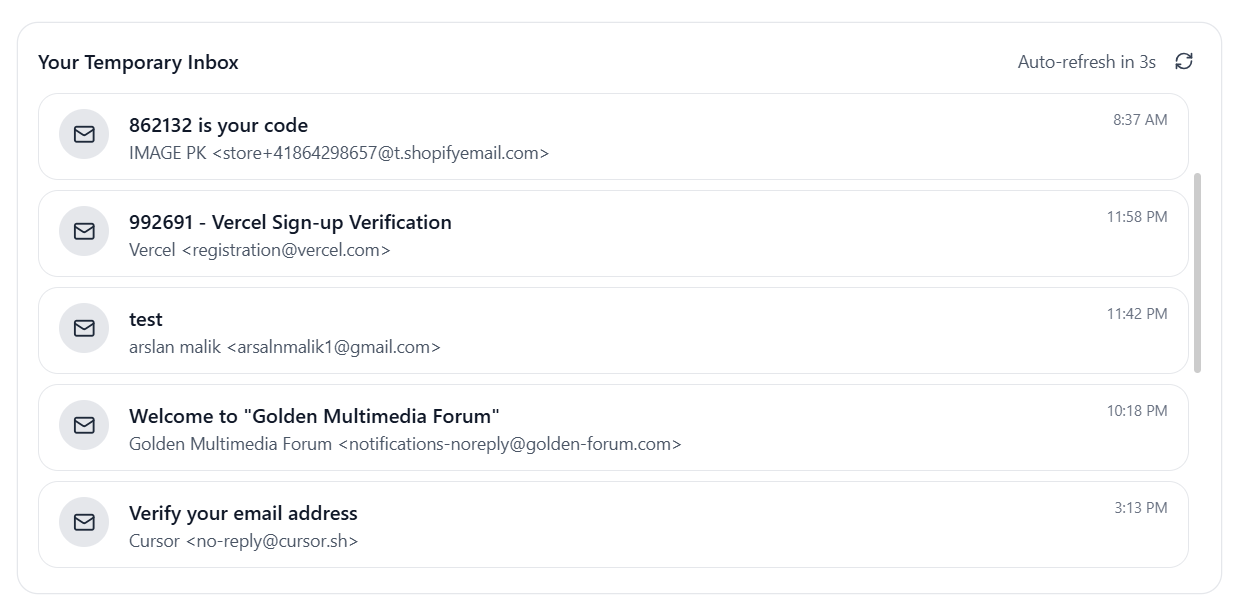
Your inbox displays received emails with sender details.
Read Messages
View email content and attachments
Click on any email to view its full content.
- Read the complete message
- Download attachments
- Copy verification codes
- View sender information
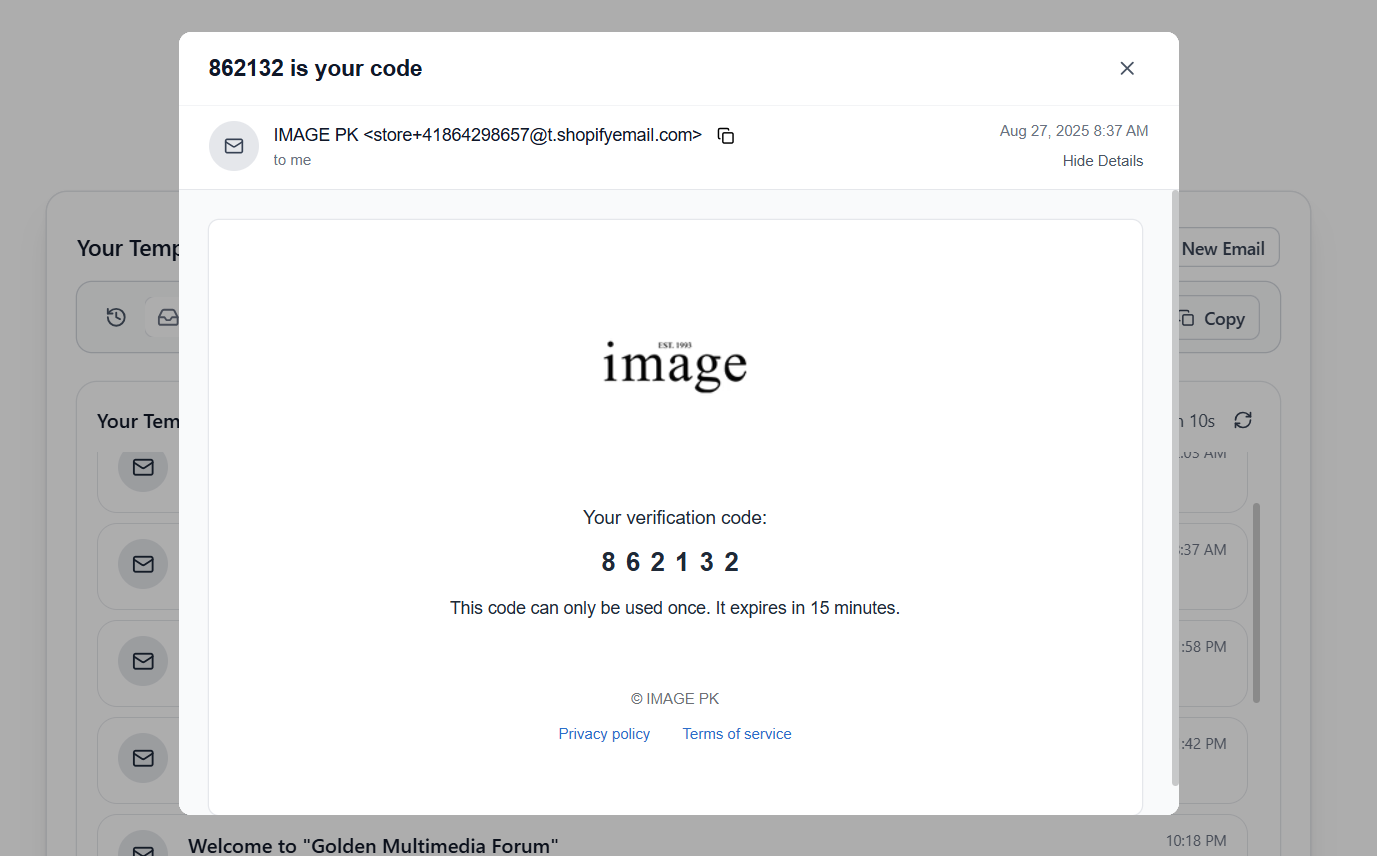
View full email content and download attachments.
Create New Email
Generate fresh addresses when needed
Click "Generate New Email" to create a new temporary address.
- A different email for another service
- To start with a fresh inbox
- Multiple temporary addresses
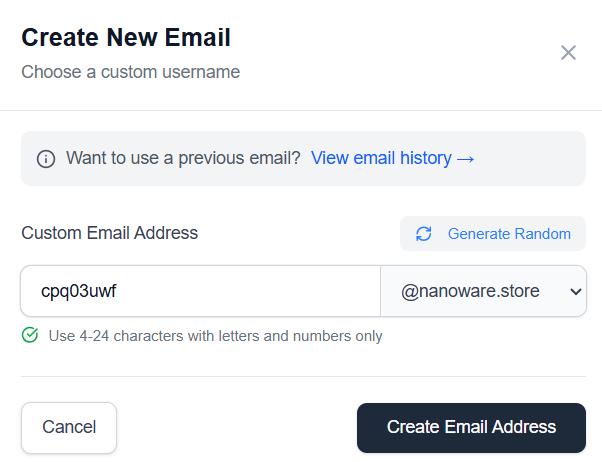
Create new temporary email addresses with one click.
What Happens Behind the Scenes
The five steps above are what you see. Here is what actually happens, because knowing it tells you what a disposable inbox is safe for.
When the page loads, we generate a random local part (the bit before the @) and pair it with one of our receiving domains. That address is registered on our mail servers immediately, which is why it works the instant it appears — there is no account to create and nothing to confirm.
When somebody sends a message to that address, our mail server accepts it, stores the message, and your open tab picks it up on its next refresh. We keep the raw message only for as long as the inbox lives: 24 hours for an ordinary inbox, or 7 days if you saved it with a link. After that the message is deleted, and the address itself is retired.
Two consequences follow from that design, and both matter:
- The address is not secret. Anyone who knows or guesses it can open the same inbox. There is no password, because there is no account. Treat every message in it as readable by someone else.
- Expiry is permanent. Once the timer runs out, the mail is gone from our side. We cannot restore it, resend it, or tell you what it said.
What a Temporary Inbox Can and Cannot Do
Most complaints about disposable email come from expecting it to behave like a real mailbox. It does not, by design.
It can
- Receive one-time passcodes and verification links, usually within seconds
- Receive HTML newsletters, plain text, and file attachments
- Hold several messages at once from different senders
- Be replaced instantly with a fresh address whenever you want a clean slate
It cannot
- Send email. These inboxes are receive-only. If a service needs you to reply from the address, a temporary inbox is the wrong tool.
- Recover an account later. If you register somewhere with a disposable address and lose the password, the reset link goes to an inbox that no longer exists. That account is gone.
- Guarantee delivery. Many sites keep lists of known disposable domains and refuse them at signup.
- Keep anything private from the sender. Mail arrives unencrypted, the same way it does everywhere else.
If Your Email Doesn't Arrive
Nearly every "it isn't working" case comes down to one of five things. Work through them in order.
- Give it 60 seconds. Most verification mail lands in under ten, but bulk senders queue messages and some take a minute or two. The inbox polls on its own — you do not need to reload the page.
- Check the address character by character. Use the copy button rather than retyping. Manually copied addresses lose a character surprisingly often, and the mail then goes to an inbox you are not watching.
- The site may block disposable domains. Banks, government portals, airlines and many ticketing sites reject them outright. If the signup form rejects the address immediately, that is what happened, and no amount of waiting will fix it. Use a real address for those.
- Your inbox may have expired. If the countdown reached zero, the address stopped accepting mail. Generate a new one and start the signup again.
- Greylisting. Some senders deliberately delay the first message to an unfamiliar address. If you are past two or three minutes, request the code again rather than waiting.
If none of that helps, the sender is almost certainly refusing disposable addresses rather than failing to send. That is a decision on their side that we cannot work around.
Choosing How Long You Need
Longer is not automatically better. A shorter window means less time for anyone who stumbles onto the address to read what is in it. Pick the shortest one that covers your task.
- 10 minutes — a single OTP or confirmation link, where you are sitting there waiting for it.
- 20 minutes — multi-step signups, or anything where you expect a second message such as a welcome mail after the confirmation.
- 30 minutes — app and download testing, where mail may arrive in stages and you are switching between windows.
- 7-day saved inbox — trials and longer projects. You get a private link that reopens the same inbox. Anyone holding that link can open it too, so keep it to yourself.
Four Rules That Keep You Out of Trouble
- Never for anything that holds money or identity. Banking, payments, insurance, tax, medical portals and government services should always get your real address. If you are locked out later, the recovery route runs through that mailbox.
- Never for an account you want to keep. If losing it would annoy you, do not register it with an inbox that deletes itself.
- Assume the contents are readable. No password protects a temporary inbox. Do not have anything sent to it that you would mind a stranger seeing.
- Do not use it to get around a ban or a rule. Evading a suspension, farming repeat trials of the same paid service, or creating accounts to manipulate a platform breaks those services' terms, and our terms prohibit it too.
Common Questions
Do I need an account?
No. There is no signup, no password and no email confirmation. Opening the page is the whole process.
Can I reply to a message?
No. Every inbox here is receive-only. If a service expects a reply from the address, you will need a normal mailbox.
Can I get the same address back later?
Only within its lifetime, and only through the saved-inbox link. Once an inbox expires the address returns to the pool, so there is no way to reclaim it.
How many addresses can I create?
There is no limit. Generate a new one whenever you want a clean inbox.
Is the service free, and how is it paid for?
It is free, with no account and no payment details. Running mail servers costs money, and the site is funded by advertising, which is why you will see ads on some pages. What we do not do is sell your data.
Are attachments safe to open?
We do not scan attachments. Apply the same caution you would in any inbox: if you did not expect the file, do not open it.
Ready to Try TempMail?
Get your temporary email address now
Go to Homepage